If any of you have been lucky enough to have Jim Brashear as a ceramics art instructor at UAF, you have also looked at Jomon pottery. Jomon pottery is ancient ceramic pottery produced in Japan. These vessels and figures were produced between 14500 BCE to 100 BCE.
I chose Jomon pottery for my blog because I really enjoy pottery and I have tried to reproduce some of the works I have found online myself. I wish I had some photos of the pieces I recreated to post here but sadly I do not.
This blog was a little difficult to write due to the fact that it is basically impossible to know who the artist of such an old piece of art could be and it is also difficult to find out when specifically it was made.
Jomon pottery has a long time line and evolved over six periods. First was the Incipient Jomon period from 14500 to 8000 BCE. Then the Initial Jomon period from 8000 to 5000 BCE. The Early Jomon period was from 5000 to 2500 BCE and then the Middle Jomon period from 2500 to 1500 BCE. After that was the Late Jomon period from 1500 to 1000 BCE and finally, there was the Final Jomon period from 1000 to 100 BCE.
Throughout these eras, the pottery changed quite a bit. In the early stages, the pottery was very unrefined. The clay was low fired in bonfires. The vessels were very simplistic and had simple designs and textures added to them. With time, the vessels became more complex and the vessels looked much “cleaner” than before. Simple kilns were even introduced.
Incipient Period
Here you can see a pot made during the incipient period. It is very simple. The base of the pot is pointed which is typical for a pot from this time period. The bases were usually not flattened until later periods. The texture looks like 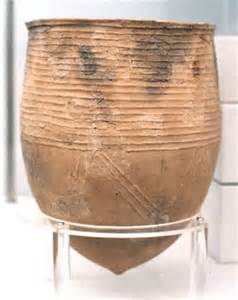 it was made using a rope or something of that sort. It also looks like it was fired in a bonfire due to the blackened edges. I find it so insane that this far back in time, people already created these vessels. I always wonder how long it must have taken to produce these pots and how the firing process must have worked. Sadly, it is impossible for me to know who made this pot as it is so old.
Middle Period
Next, I skipped ahead to the middle 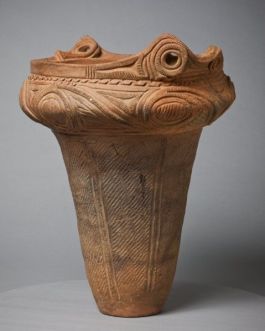 period since the early period and incipient period are very similar in style. To the left, you can see a vessel made during the middle period. The bottom of the pot has been flattened out at this point and there are more designs added that are less simplistic than the ones from the previous periods. I really love this pot and all the designs added at the top of it.
Below is another pot that is also said to have been made during the middle period. The later middle period often had many coils incorporated in their pots which I wanted to 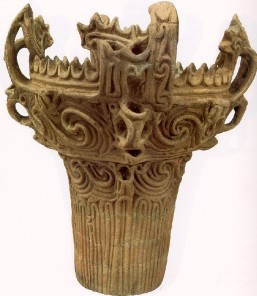 demonstrate with this pot here. If anyone has ever made a larger vessel our of coils knows how long it takes. I have spent many hours making a large coiled vessel and it is very difficult since they can fall apart so easily if clay is too wet or too dry. I would have to say, after making a coiled vessel, I truly appreciate the wheel. So looking at these pots really blows my mind.
Final Period
Once again, I skipped ahead since there are many similarities within the late and final period. Many of them revolving around dogus. During the final period, many more ornate figurines were produced along with pots. Maybe you have seen the famous dogu figures before which you can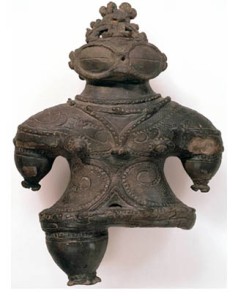 see here to the right. It was common during this time for figurines to have large bug eyes like this. Many other dogus had other strange features like horns or cat faces. Dogus were pretty common humanoid clay figures that were produced during this time. We have actually dug up about 18,000 of them and you can find them in many museums so you may have possibly come across one at some point. There are many theories on why so many dogus were created here during this time. One of which is that the figurine was portraying the “mother goddess” or Venus. However, others believe they were simply made to be toys. Whatever the reason, I am glad they have made it this far and we can see them today. This dogu is located in the Tokyo National Museum.
A Modern Twist
I wanted to add a little modern twist to the blog as it revolves around very old pieces of art. During my research, I found a Japanese artist whose art is very influenced by the historical Jomon design. Taro Okamoto was born on February 26, 1911 in Kawasaki City, Japan. As he got older, he began oil 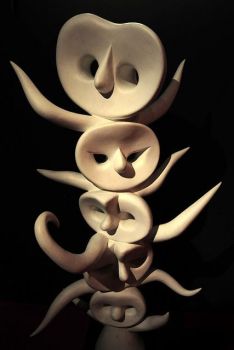 painting at the Tokyo Fine Arts School. He later moved to Paris with his parents where he continued studying art. He was very influenced by Picasso’s art and how abstract it was as well. He was able to travel around quite a bit producing art in different countries such as Mexico. After his death in 1996, the Taro Okamoto Museum of Art was opened in honor of him in Tama Ward, Japan. You can also visit his old studio and home which is located in Aoyama in Tokyo. To the left, you can see probably his most famous sculpture, the Tower of the Sun made in 1970. I chose this piece because it really does have those strange faces that many of the Jomon figurines have. I also chose it since it was a sculpture instead of a painting like many of his other pieces. They have flat simple faces and large eyes. But they also are very abstract. Many of his paintings do remind me a lot of a mix between Jomon design and Picasso’s artwork. it’s really incredible to look at and to see the similarities.
I just really enjoy looking at these vessels and figurines and have been lucky enough to see them in some museums I have visited in the past. Hopefully when you come across one of these in the future, you will be able to identify it or remember some of the history that goes along with these amazing pieces. (more…)
 diverse heritage with a Haitian-American father and a Puerto Rican mother. His diversity fueled a lot of his inspiration and he quickly became known in the area for his graffiti in the late 1970 where he was known under the name SAMO. In 1980, he finally really broke through and became very famous for his very unconventional art. People were willing to spend $50,000 for an original Basquiat painting at this point. Basquiat also went on to collaborate with Andy Warhol and produced a show together. Sadly, as Basquiat became more famous, he also started doing more drugs. He was
  addicted to heroin and as the fame grew, he grew more paranoid and isolated himself from everyone he knew. He died of a drug overdose on August 12, 1988. Luckily, we have his artwork to remember him by as he was very talented and creative. There is definitely a lot going on in his artwork as you can see to the right. This painting is called
  the Early Modern content, he continued to produce art later on as well. Andy Warhol was born in Pittsburg, Pennsylvania on August 6, 1928. He became widely known during the 1960s Pop art movement. People who have never been to a museum usually even know who Andy Warhol. His mother had a great influence on his art career as she got him to start painting and drawing. She also bought him his first camera at age nine, which led to him starting photography as well. Warhol participated in many forms of art and felt very passionately about them. He graduated from college with a degree in fine arts in 1949 and moved to New York City. He landed a job with Glamour magazine and became a hugely known commercial artist. Warhol started producing artwork of very simple items, like the Campbell soup cans we all know of. He went on to open an art studio in a warehouse named The Factory and held
  many parties large parties there where multiple celebrities were always present. In 1963, Warhol almost died when he was shot by a woman named Valeria Solanis who was upset with him over a script she had written for him. A while later, he met Basquiat. A piece that they made together was the
  started drawing anamorphic pavement illusions, which are his famous 3D chalk art pieces.
 realistic and it amazes me how Beever was able to do this with chalk. The second piece I chose is a 3D drawing called Swimming Pool in the High Street which you can see to the left. This was made in Glasgow Scotland. A little below, you can see it from another angle which makes you realize just how difficult it
 Beever’s. Wenner used to work for NASA but then moved to Italy to pursue his love for classical art. He studied the arts of the Renaissance era and also got much of his inspiration from the works of that time. In 1984, Wenner started drawing anamorphic chalk drawings. He quickly became famous because of documentaries on him that actually inspired pavement art festivals. Wenner went on to train other artists in anamorphism. At one point, Wenner was
  commissioned to make a street painting based on The Last Judgment which you can see to the right. 30 of Europe’s best painters, including Wenner spent 10 days producing the piece. Pope John Paul II then signed it and officially recognized the piece as a work of sacred art. It was painted in Mantua, Italy. I thought this was a really amazing accomplishment.
 obviously received a lot of negative feedback from many people and the original is actually nowhere to be found now so Duchamp has reproduced it a few times. Duchamp actually defended this piece stating that he had “created a new thought for that object.” He disagreed with others who claimed that art must be a “craft of the hand” and that art really only should have something to do with the artist’s idea’s of/for the work. I feel like this is a little farfetched to be considered art and I also believe Duchamp was being sarcastic with this piece, but it has stayed famous for all this time and has gotten a lot of attention so maybe Duchamp was on to something.

 somewhere in between when it comes to the artwork. I feel like the work can be exceptionally beautiful but I also feel like it gives it a more loose look, whereas paintings from the Renaissance era have very clear lines and are more focused looking. I also like the way paintings from the Renaissance seem to have brighter colors. I added the photo to the right, a part of the painting the Primavera by Sandro Botticelli from the Renaissance era, so you could compare it to the following paintings produced during the Impressionism movement. They are definitely very different from one another and I suppose I just prefer the paintings of the Renaissance. One thing I do really enjoy about Impressionism though is that the paintings are very unique from one another. As if the different painters also had more of their own personal style involved. In previous era’s, paintings all looked very similar from one artist to the next.
 Monet oftentimes painted series like this where he painted the same objects at different times of the day to capture the light differently. Monet was quite talented at painting and depicting natural light as that is what he focused on in almost all of his paintings. Once again, I find the painting very beautiful, but I also find it very blurry. However, I know many people absolutely love this style and Monet’s paintings (like my best friend) so I suppose I just have different taste in art.
 An example would be this photo to the right, Confederate Soldiers Dead by a Fence taken by
  that to be true even now in our modern times, there are photographers who take photos for journalism and photographers who take photos for art. But here Is another instance of early photography. The photograph to the left is The Manger taken by
  Schikaneder